
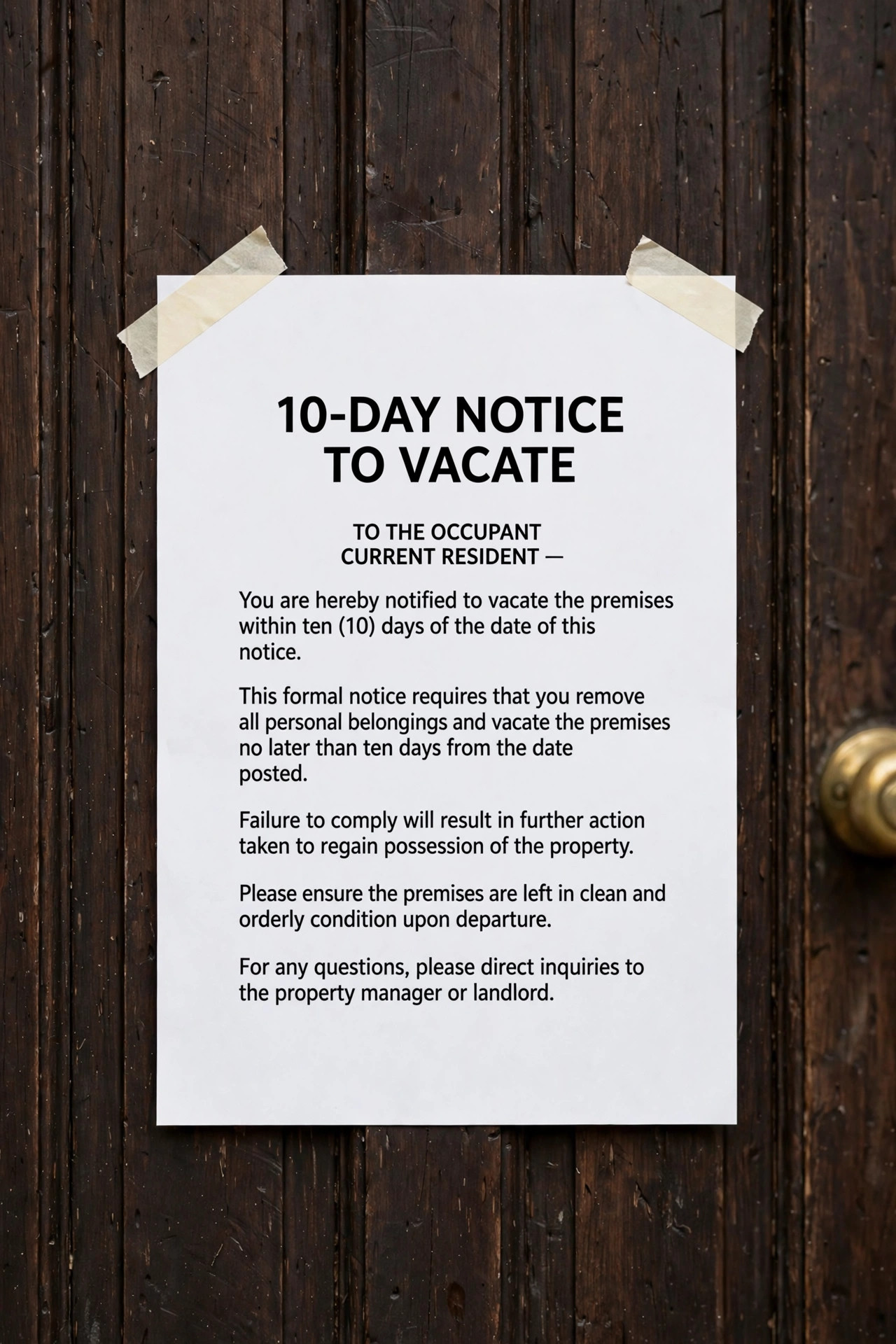
Do squatters have rights in Colorado? Why one bank statement can freeze the scene.
The dangerous misconception is that a piece of mail—or a bank statement—makes someone a tenant. It does not. It does not create a legal tenancy, override a deed, or give an unauthorized occupant ownership rights under Colorado law.
But it can still be used as a tactic. An unauthorized occupant may arrange for mail or an account statement to arrive at the property, then point to it as supposed proof of residency when officers respond. The objective is not to win the ownership argument on the spot. It is to create enough uncertainty to push the confrontation out of the criminal-trespass lane and into the slower civil process.
The Denver Police Department Operations Manual explains why that gray zone matters: occupancy disputes are generally handled as civil matters unless there is sufficient evidence that a crime occurred. A claimed residency, disputed permission, or questionable paperwork can make officers reluctant to decide possession at the doorway.
How Colorado’s unauthorized-occupant process works.
Colorado landlords should know the faster statutory path created by SB18-015 in 2018. Under the enacted law, an owner or authorized agent files a complaint and verified motion for a temporary mandatory injunction in county court. The court must schedule a hearing as soon as practicable, but no later than the next court date. If the court grants the injunction, the sheriff must remove the unauthorized person within 24 hours after receiving the order.
The court—not an officer at the doorway—is the gatekeeper. A person who can show a lease, permission, payment, or another credible claim of right may place the dispute outside this narrow process and into ordinary landlord-tenant proceedings. A false verified filing can also expose the owner to actual damages, attorney fees, and costs.
Do not let the civil-versus-criminal gray zone make the decision. Ask counsel whether the facts fit Colorado’s county-court injunction process and preserve the deed, lease records, payment history, communications, condition photos, and any video that bears on permission or entry.

Can a Denver landlord shut off utilities or change the locks?
CRS 38-12-510 makes it unlawful for a landlord to remove or exclude a tenant without court process. The statute specifically includes willfully terminating utilities or removing doors, windows, or locks, except as required for repair or maintenance.
In a squatter case, whether the occupant has any lawful tenancy is often the very fact in dispute. Once officers will not remove the person and the dispute is in the civil lane, a landlord should not gamble on “self-help.” Do not shut off heat, water, hot water, electric, gas, or other essential services. Do not change the locks. Do not try to make the residence uninhabitable. Use the court process with fact-specific legal guidance.
The prohibition on self-help does not change when the owner believes the occupant lacks permission. Until a court or another lawful process resolves the dispute, an owner who terminates essential services or excludes the occupant may create substantial legal exposure.
What Wyoming passed in 2025—and why Colorado landlords are paying attention.
Wyoming’s 2025 Senate File 0006, enacted as Senate Enrolled Act No. 20, is titled “Residential Property Removal of Unlawful Occupant.” Gov. Mark Gordon allowed it to become law without his signature after raising due-process concerns. It took effect July 1, 2025.
The law creates a limited alternative remedy for owners facing unauthorized occupants who are not current or former tenants and are not the owner’s spouse, child, or parent. An owner or authorized agent files a sworn complaint with law enforcement under penalty of perjury. After verifying record ownership and the statutory conditions, officers must give notice to vacate “without delay” and put the owner back in possession.
- No pending litigation: the shortcut does not apply when the owner and occupant already have a case in court.
- No landlord-tenant shortcut: current or former tenants under written or oral rental agreements are excluded.
- Ownership verification: law enforcement must verify the complainant is the record owner entitled to relief.
- Consequences for false claims: a wrongful removal can lead to restoration of possession, actual damages, three times fair-market rental value for the removal period, court costs, and attorney fees.
Once notice is served or posted, the owner may ask law enforcement to stand by while locks are changed and personal property is moved to or near the property line. This is not permission for ordinary landlord self-help; it is a law-enforcement-supervised process limited to qualifying unauthorized occupants.
The act also makes it a misdemeanor to knowingly present a false lease, deed, or other instrument in order to remain on property—punishable by up to six months in jail and/or a $750 fine. Fraudulently advertising or leasing residential property without a lawful ownership or leasehold interest can be a felony punishable by up to two years and/or $5,000.
It creates another felony carrying up to 10 years in prison and/or a $10,000 fine when someone unlawfully occupies or trespasses in a dwelling and knowingly damages property there, regardless of the dollar amount of damage. The law does not specifically identify mail or a bank statement as fraudulent occupancy documents; it targets false leases, deeds, and other instruments purporting to convey real-property rights.
Wyoming versus Colorado: the key difference is the gatekeeper.
Wyoming
The owner’s sworn complaint goes directly to law enforcement. The sheriff verifies record ownership and, if the criteria are met, acts “without delay.” No judge’s order is required first.
Colorado
The owner files a complaint and verified motion in county court. A judge hears the matter as soon as practicable, no later than the next court date; the sheriff acts within 24 hours only after receiving the court order.
Colorado already recognizes a distinction between tenants and unauthorized occupants. But its 2018 pathway retains a judge as gatekeeper. Wyoming’s newer pathway moves the first decision to law enforcement, balancing speed with a sworn complaint, ownership verification, exclusions for tenants and immediate family, and significant damages for wrongful removal.
That balance is the real policy question. Gov. Gordon said owners deserve an effective, efficient, and fair process, but warned that adequate due process is still needed so authorized occupants are not harmed by an erroneous request. Colorado should not copy a headline; it should debate the actual safeguards.
How long does eviction take in Colorado?
If the expedited injunction route does not fit and the case proceeds through eviction, the statutory sequence can create a punishing floor even when the case is uncontested:
- 10-day demand before filing in a typical covered eviction.
- Hearing 7–14 days after filing.
- Writ not executable until 10 days after judgment—or 30 days for households receiving SSI, SSDI, or TANF.
Put together, the practical floor is roughly 30+ days from the demand letter to lawful removal even when the matter is uncontested. If the case is disputed, continued, or procedurally complicated, the meter keeps running. Common Sense Institute’s 2022 analysis placed Colorado eviction cases on a range of 2 weeks to 4 months.
During that time, the landlord may still be carrying the mortgage, insurance, taxes, utilities, trash, sewer, legal bills, and lost rent—with no guarantee the property comes back in rentable condition.
Denver’s court volume is at record levels. Owners pay their own way.
Colorado Apartment Association testimony separately put a typical housing provider’s loss near $10,000 in an eviction action. Again, that is an industry estimate—not an official Denver average—but it captures the collision of unpaid rent, legal fees, court costs, cleanup, repairs, and turnover.
At the same time, Denver approved $480K in 2026, with up to $1.27M through 2028, for tenant eviction legal services. Tenants may qualify for publicly supported representation. Landlords fund their own fight.
What public staffing data can—and cannot—show.
October 2025 reporting found that only 67% of Denver Sheriff Department deputy positions were filled. That figure describes department-wide jail staffing. It is not an eviction-unit staffing figure, and no public headcount was found for the civil unit that executes evictions.
The responsible takeaway is limited: the department executing court-ordered removals operates inside a strained agency, while owners cannot lawfully remove occupants themselves. Never assume a judgment means immediate physical possession—and never assume the wait is cost-free.
What Denver landlords should do now.
- Inspect vacant property consistently. Secure doors and windows, control mail delivery, keep exterior areas maintained, and use cameras where lawful.
- Keep ownership evidence ready. Store the deed, insurance records, utility records, dated condition photos, access logs, and all communications where you can retrieve them immediately.
- Call law enforcement when the facts support it. Report an active break-in, trespass, threat, or property damage. Be prepared to show ownership and explain why the occupant lacks permission.
- Ask whether Colorado’s county-court injunction process fits. If the occupant is not a tenant, relative, or anyone who received permission, speak with counsel about the narrow unauthorized-occupant route.
- Do not use self-help. Do not change locks, shut off utilities, remove belongings, or threaten an occupant without lawful authority. A wrong move can turn the owner into the defendant.
- Act before the facts become harder to document. The longer an unauthorized occupant remains, the more time there is for mail, documents, conflicting claims, and damage to complicate the case.
A six-point agenda for Colorado’s small landlords.
Colorado landlords can ask city councils, county commissioners, sheriffs, district attorneys, and state legislators to work together on a narrow unauthorized-occupant remedy—not a shortcut around tenant protections. The most productive request is specific:
- Create a fast, clearly defined process. Set firm timelines for judicial review and sheriff execution when a verified owner alleges unlawful entry by a non-tenant.
- Keep tenant disputes out of it. Exclude current and former tenants, family members, and cases with pending litigation, as Wyoming does.
- Address fraudulent documents directly. Create clear penalties for knowingly presenting fake leases, deeds, or other instruments to claim possession.
- Preserve due process. Require a sworn filing, ownership verification, documented notice, and meaningful remedies when an owner makes a false claim.
- Fund the people who execute the law. A statutory remedy means little if courts and sheriff civil units do not have enough staff to move legitimate cases promptly.
- Publish performance data. Ask agencies to report filing volumes, processing times, removal outcomes, fraud referrals, and wrongful-removal claims so reforms can be judged by evidence.
When contacting a governing authority, lead with the distinction: this is about people who were never tenants and never had the owner’s authorization. Ask what expedited remedy is actually available now, how long it takes locally, and whether officials would support a guarded process modeled on Wyoming’s law while preserving Colorado due process.
Denver squatter rights FAQ
Do squatters have rights in Colorado?
Occupying a property or receiving mail there does not automatically create ownership or a legal tenancy. But a disputed claim of residency can move the matter into a civil process, so Colorado property owners should avoid self-help and get fact-specific legal guidance.
Does receiving mail establish residency or tenant rights in Denver?
A piece of mail or bank statement does not by itself create a lease, tenancy, or ownership right. It can, however, be presented as evidence of residency and complicate an officer’s decision at the scene.
How do you legally remove a squatter in Colorado?
Depending on the facts, an owner may need the eviction process or may be able to use Colorado’s county-court injunction procedure for unauthorized occupants. The expedited route is narrow, and owners should consult a licensed Colorado real estate attorney before choosing a path.
Can a Denver landlord change the locks or shut off utilities?
Once an occupancy dispute is treated as a civil matter, changing locks or terminating essential services can create legal exposure for the owner. Do not use self-help; follow the court process or another lawful procedure with legal guidance.
How long does the Colorado eviction process take?
The statutory steps described in this guide can create a practical floor of roughly 30 or more days in an uncontested case. Disputes, continuances, service issues, and enforcement delays can extend the timeline.
Sources and further reading
- Wyoming Legislature: SF0006 engrossed text
- Wyoming Tribune Eagle: new unlawful-occupant removal law
- Wyoming Livestock Roundup: enactment and Gov. Gordon’s statements
- Colorado General Assembly: signed SB18-015
- Colorado Revised Statutes § 38-12-510: unlawful removal or exclusion
- Denver Police Department Operations Manual
- Common Sense Institute: Colorado eviction timing
- Senator Michael Bennet: Denver eviction filing totals
- SmartScreen: national eviction cost estimates
- Law Week Colorado: Colorado Apartment Association testimony
- The Badger: Denver eviction legal-services funding
- Colorado Public Radio: Denver Sheriff Department staffing